A Fragrant Memory by Mary van Eeghen-Boissevain
An extract from The Golden Book of Rabindranath Tagore (p.76-77, 1961)
—
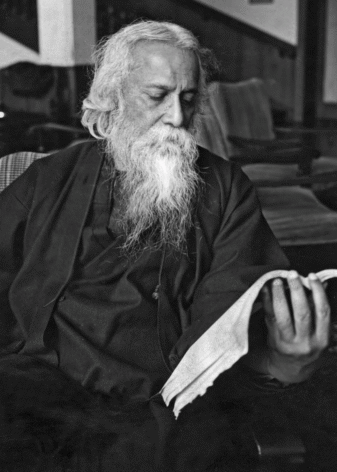
In September 1920, we had the joy of welcoming ‘the Poet’ to our home in Holland.
Our house was on the coast of the Zuider Sea and we had a wide and
lovely view towards the setting sun. When I look back on the time the Poet spent
with us, two vivid memories stand forth in pure relief against the background of
many hours filled with joy. For that was for me the ground note of the whole
symphony; joy, creative joy, life-giving joy,—his love for nature, the sky, the wind,
the flowers. Often while he was with us I remembered the saying of One of the Great
Teachers of Mankind: “Except ye become as little children, ye enter not the
kingdom of Heaven.” I have felt him as one who gets nearest to the heart of man,
through the heart of Nature.
The first of the two vivid memories was when he entered our house. In the
hall he stood still, raised his head, closed his eyes and was quite silent—then he
bent his head as it were in greeting and moved on through the room ; and as he
passed a large bowl of red, living roses on the centre table, he let his fingers stray
over the roses tenderly, full of understanding and love and recognition. That
gesture revealed him to us as much as his poems.
The second memory is of an evening. A young girl sang some of his poems
put to western music. At that time we did not know that each of his songs had
music of its own, so we were ignorant of our very stupid attempt at entertaining
the much-to-be-pitied poet. There were also some songs of Schumann, which were
more appreciated. After the guests were gone, the poet sat in front of the fire, his
hands folded on his knees, staring into the fire. I asked him: “Master, will you
let us hear your own songs in your own words? May we take part in the life
which is expressed when you sing your lndian music?” Great silence! Down
in the hall the old Dutch clock ticked away time—the wood fell together in the
fire and sent out a fountain of sparks into the silence—we waited—then he lifted
his voice saying:
“This is the song we sing at sunset. We sit looking out over vast distances,
we sing of the sadness of human existence, also of the longing in our hearts for union
with God, we sing of the joy of our senses when we see the light, hear the songs,
smell all the delicate odours from the Mother-Earth when the sun sets. We sing of
the love in our hearts, not only the love of one man for one woman: but of the love
in the heart of humanity, the longing, the sadness, the pain and the joy of all the
world—that is our sunset song.” The poet’s voice rose and soared to the flame-lit
rafters ; it sank and became flute-like and again swelled out in waves or took over
the shadows and pictures of the flames ; hearing and seeing were merged into one
great experience ; joy and sorrow came from one source deep in the heart of the
world, and from the heights above ; time was not ; the clock had lost its power of
being a messenger to us—we heard it not. We were lifted up and merged into
unity with Love and Compassion. That hour will live in our hearts as long as we
live.
There are two sayings which I want to bring before you as so very typical
of the poet’s vision on life. One was uttered when we had been talking about the
education of woman and of her place in life. The poet said: ‘Teach girls to
realise that their greatest influence is the personal contact with their surroundings
in the making of a home or in educating youth. Therefore they should be trained
to give out freely and pleasantly what they were taught. The atmosphere of
culture and light which is so created, is the centre of beautiful home life. Great
trouble should be taken to teach girls to express themselves in beautiful and simple
language, to give out their knowledge and experience, and their wisdom, their
thoughts, their dreams, their visions. The legends of the world are made eternal
through woman’s gift of story-telling. While man can express himself truly and
well in work and deeds, woman does so best of all through personal contact with
her surroundings. It is easier for children to learn through stories than through
books. And so a cultured and beautiful home influence can be theirs through the
gift of story-telling. The women who take care of the children of the world must
be story-tellers, and so set free the children’s own fantasy.’
The second saying was about a statue of Rodin’s, called ‘Protection.’ The
poet said: ‘ln India we would feel protection to be more of a static force, like a bird
on the nest, or a Buddha sitting silent and full of inner peace; you in the West are
too strenuous. Power is in stillness as much as in movement.’
I must stop writing about our well-beloved poet, but it is difficult. So many
wonderful pictures pass before my inner vision.
Mary van Eeghen-Boissevain
Naarden, Holland