On this page you can read two accounts: the first is from Pushpa Shankar, and below you find one from Vinodh Ilangovan. They both participated in the Dance Residency in Naarden between 23 and 29 June 2026
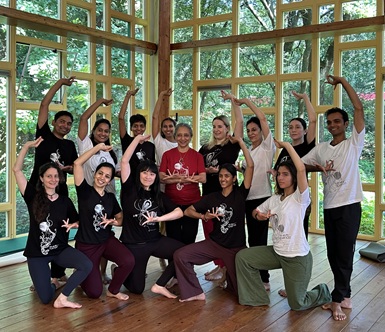
Some experiences stay with you long after the last step has been danced. My residential dance residency in the Netherlands, from 23 to 29 June, was one such experience—a week that brought together dance, learning, friendship, history, and a deep sense of being part of something much larger than oneself.
The residency was conducted by Guru Leela Samson and Bhavajan Kumar, and brought together dancers and students from different parts of the world. For six nights and seven days, we lived, learned, danced, ate, discussed, laughed, and shared our lives under one roof. It was much more than attending a dance workshop; it was an experience of living within a shared artistic space.
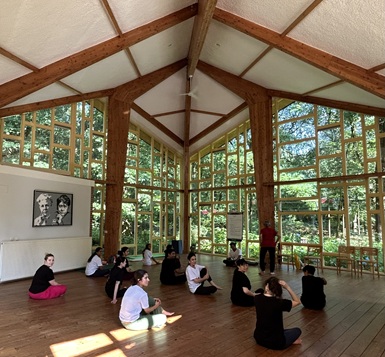
Each morning began gently—with yoga or a walk—allowing the body and mind to prepare for the long day ahead. The rest of the day was immersed in dance. The first half was devoted entirely to Nritta, the pure dance aspect of Bharatanatyam, exploring movement, rhythm, technique, and the vocabulary of the form. The second half shifted into Abhinaya, taking us deeper into expression, interpretation, emotion, and the many layers through which a dancer communicates.
Spending an entire week in such an intensive environment offered something that a regular workshop often cannot. There was time to absorb, revisit, question, observe, and simply live with the material. The learning continued even outside the formal sessions—in conversations over meals, informal discussions, watching one another practise, and exchanging perspectives about dance and life.
And then there were the people.
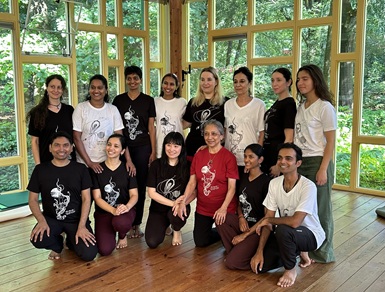
Participants had travelled from different parts of the world, each bringing their own experiences, backgrounds, and relationship with dance. In those seven days, strangers became friends. We spoke about much more than Bharatanatyam—about our lives, our journeys, our cultures, our interests, our struggles, and the many things that bring people together. The residency created a beautiful sense of community, where dance became the starting point for much deeper connections.
One of the particularly memorable moments was the opportunity to witness Guru Leela Samson and Bhavajan Kumar perform at Besant Hall. To see them perform within the very environment in which we had spent the week learning was deeply inspiring. It gave us the opportunity not only to learn from our teachers in the studio, but also to experience their artistry on stage.
Yet perhaps what made this residency truly extraordinary was the place itself.
The centre carries more than a hundred years of history and is connected to the Theosophical Society, founded through the work of figures such as Annie Besant. Walking through the premises, one could not help but feel that the walls carried memories of generations of thinkers, artists, spiritual seekers, and cultural figures.
The connection to Indian dance history made the experience even more profound, especially when I learnt that Smt. Rukmini Devi Arundale, one of the most revolutionary figures in the revival and transformation of Bharatanatyam, regularly visited the centre. Knowing that she had walked through these very spaces and had been associated with the place gave the residency an entirely different dimension. We were not simply practising Bharatanatyam in a beautiful location—we were learning within a space that had itself witnessed important chapters in the history of Indian art and culture.
We also had the opportunity to visit St. Michael’s House. Our new friend Isolda [red: Isolde Sültemeyer] took us to visit the house, where Rukmini Devi Arundale would stay during her visits to the Naarden centre. Standing in a place associated with her journeys and her work felt like encountering a small, tangible piece of dance history.
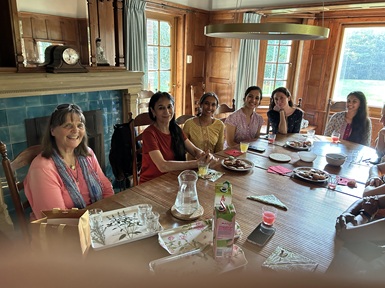
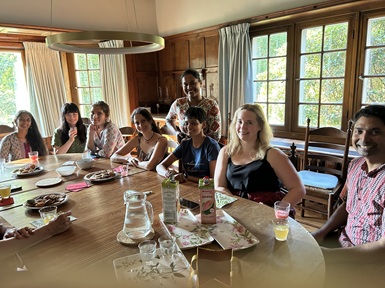
The historical connections extend beyond dance as well. Rabindranath Tagore had also visited the centre, adding another remarkable layer to its cultural legacy.
For me, this residency therefore became a meeting point between past and present—between the lineage of Bharatanatyam and its contemporary practitioners, between a century-old cultural history and a group of dancers from around the world who had gathered there in the present day.
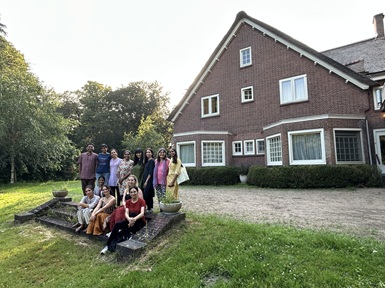
Looking back, I realize that the most valuable part of the residency was not only what I learnt in the dance studio. It was the experience of being completely immersed in dance for a week; of waking up each morning to movement; of learning from experienced artists; of sharing space with fellow dancers; of discovering new friendships; and of being surrounded by a place that holds such a significant history.
Six days may sound like a short period of time, but within that week, so much was experienced. I returned with new material to work on, new questions to explore, new friendships to cherish, and a renewed appreciation for the journey of Bharatanatyam. Most importantly, I returned with the feeling that I had not merely attended a workshop—I had lived a week inside a living tradition.
And that is perhaps what made this residency so special.
Reflections on the Naarden Residency
Vinodh Ilangovan, Hannover
I had the opportunity to participate in the Dance Residency at the International Theosophical Centre (ITC) in Naarden, the Netherlands. Held from 23–29 June and guided by Leela Samson and Bhavajan Kumar, the residency offered an immersive week of learning and reflecting on Bharathnatyam. Apart from learning two new dance items, we also had an opportunity to understand the histories, people and ideas that have travelled alongside the art form. To learn from Leela Samson, a student of Rukmini Devi Arundale added a layer to that continuity as ITC Naarden carries an interesting connection to its founding director. Dance became a way of encountering history through the body: learning, questioning, remembering and discovering.
There is an even earlier Indian connection embedded in the history of the estate. In September 1920, Rabindranath Tagore stayed with Mary van Eeghen at her home there, years before the property became the International Theosophical Centre. These histories came alive through the research and stories shared by Isolde Sültemeyer. Her work has helped preserve memories of Rukmini Devi’s relationship with Naarden and uncover connections between Rukmini Devi, Tagore and Mary van Eeghen. Listening to these stories while physically inhabiting the same landscape made history feel less like a sequence of dates and more like a network of people, encounters and ideas.
Another special part of the residency was having access to the library at the ITC. The library was opened to us as residency participants, giving us the freedom to browse its collection. For a curious learner, it was a wonderful complement to the physical practice of dance. Between sessions, I and some of my fellow residency participants wander through the shelves, follow an unexpected reference, or simply allow one subject to lead to another. It reinforced something I felt throughout the residency: learning dance does not happen only through the body or in the class, it can also grow through reading, conversation, history and the unexpected connections we make between them. It reminded me that learning an art form is also an invitation to remain curious about the people, places and histories that have shaped it.